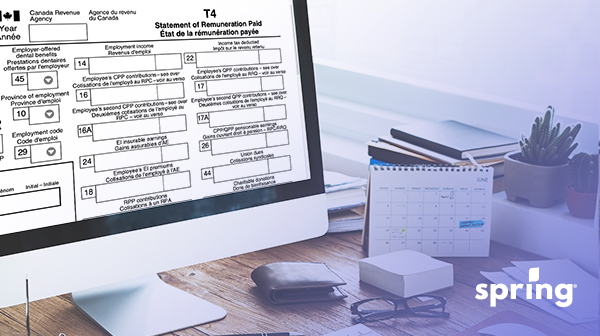
In Canada, though, only some receive a T4. T4s are only given to those who work for an employer, as they include payroll deductions. Self-employed workers won’t receive a T4. Instead, you’ll have to compile all of your income and earning receipts together and calculate what you owe.
As someone who is employed, you don’t have to do that; a T4 does it for you. This form is usually administered by the payroll department, and if you have multiple jobs, you’ll likely receive multiple T4s. That said, what each employee receives is different since everyone’s employment situation is different.
How T4’s Work
A T4 slip is also referred to as a statement of remuneration paid. It breaks down the amounts paid to an employee by an employer throughout the previous calendar year. It contains all of your personal tax information and breaks down how much money you paid.
It shows what part of your income is taxable income, net income, total income, what is paid to CPP (Canada Pension Plan), EI and income tax paid. It also shows any pension contributions that were made, as well as any other deductions.
While some can do their income taxes with just a T4, others may need more than one T4 or other required tax information for other payments received for services rendered. This is because T4s don’t contain all of your tax information. It just contains the information from your employer.
If you have more than one employer, then you’ll receive more than one T4. In fact, you’ll receive some form of tax slip for any type of taxable income (including investment income) you receive during the calendar year. Any employment expenses that you have aren’t included on a T4. That said, there are separate forms you can request from your employer to claim these other employment expenses on your income taxes.
As an employer, you can find fillable T4 forms right on the CRA’s website.
When T4’s Are Administered
While T4s are required by employers to administer to Canadian employees, there’s also a date that they have to be administered. They do have to be sent out by the end of February as the due date. With that in mind, though, most T4s will be received well before then, giving you time to compile your tax information before it’s time to file.
How many T4s you should receive is based on what your forms of income were for the tax year. You must have received them all for your primary income, as well as any other income, before you can file. If you haven’t received all of your T4s, then you should try to get them from your previous employer for the past year, as well as any other previous tax years you may be missing.
Getting Your T4 From a Previous Employer
Before you can file your annual income tax return, you must receive all of your T4’s and tax slips from any taxable income you earned during that tax year. If you no longer work for any of the employers from whom you require tax slips, you should receive this slip via email or through the mail.
Either way, you should get it before the end of February. If you don’t receive a T4 by then, then your best bet, as a former employee, is to start by contacting your former employer. Even if they no longer have the original T4, they’ll be able to get a copy and get it sent over to you. Chances are, the reason that you haven’t received your T4 is that your address has changed, so the form was sent to your previous mailing address.
CRA Website and T4’s
Another way for previous employees to get a copy of T4 tax slips online is through the CRA’s MyAccount website. As long as you have an online account, you should be able to see any T4s that were uploaded for the current tax year, as well as previous years. These can usually be found sometime around the middle of March after your employer submits the T4s to the CRA (Canada Revenue Agency). If you don’t have a MyAccount, you can create one, but it will take a few business days since you’ll need a code from the CRA to activate the account.
While a CRA account isn’t required to file your tax return, it is one of the simplest ways to do so. Whether you file your taxes yourself or through a tax professional, you can use your CRA account to download all of your tax information and avoid the process of entering it manually. This is also ideal if you’re unable to track down a T4 from a previous employer, since it should be found here.
T4’s From Service Canada
The type of tax you’ll receive from government taxable benefits depends on the type of income you’re receiving. The most common is EI, also known as Employment Insurance. Since the funds from EI are taxable, you do have to claim this income as taxable income on your annual income tax return.
If you’re looking for your tax form from your EI earnings, then you’ll receive a form called the T4E form. You should receive this form in the mail, but you can also get it as early as February 1 using your My Service Canada Account. It will also be filed under your MyAccount with the CRA, although it may not appear there until later. Either way, this form can be found online when it’s time to file.

Breakdown of T4 Slip
In Canada, a T4 slip contains Many different boxes that provide a breakdown of your annual earnings. Each T4 will have a breakdown of these for every employer you worked for.
Let’s look at the different boxes available on a T4 and what each one of them means. Before we do that, though, it’s important to note that each T4 will include the following information at the top:
- Year
- Employer’s Name
- Employee Name and Address
| Box Number | What it Includes |
| 10 | Province of Employment |
| 12 | Social Insurance Number |
| 28 | Exempt (CPP/QPP (Quebec Pension Plan), EI, and PPIP) |
| 29 | Employment Code |
| 45 | Dental Benefits Offered by Employer |
| 54 | Employers Account Number |
| 14 | Employment Earnings (Includes taxable benefits and taxable allowances) |
| 16 | CPP Contributions Made By Employee |
| 16A | 2nd CPP Contributions Made By Employee |
| 17 | QPP Contributions |
| 17A | 2nd QPP Contributions |
| 18 | Employee’s EI Premiums |
| 22 | Income Tax Deducted |
| 24 | EI Insurable Earnings |
| 26 | CPP/QPP Pensionable Earnings |
| 55 | Employee’s PPIP Premiums |
| 56 | PPIP Insurable Earnings |
| 20 | RPP Contributions (Registered Pension Plan) |
| 50 | RPP or DPSP Registration Number |
| 52 | Pension Adjustment |
| 44 | Union Dues |
| 46 | Charitable Donations |
These are the most common boxes you’re going to find filled on your T4 in Canada. That said, there are some other codes as well.
Other T4 Boxes
| Box Number | What It Includes |
| 15 | Payer-offered Dental Benefits |
| 30 | Board and Lodging |
| 31 | Special Work Site |
| 32 | Travel in a Prescribed Zone |
| 33 | Medical Travel Assistance |
| 34 | Personal Use of Employer’s Vehicle |
| 36 | Interest-Free and Low-Interest Loans |
| 38 | Security Option Benefits |
| 39 | Security Options Deduction |
| 40 | Other Taxable Allowances and Benefits |
| 41 | Security Options Deduction |
| 42 | Employment Commissions |
| 43 | Canadian Armed Forces Personnel and Police Deduction |
| 45 | Employer-offered Dental Benefits |
| 66 | Eligible Retiring Allowances |
| 67 | Non-Eligible Retiring Allowances |
| 69 | Indian (Exempt Income) – Non-Eligible Retiring Allowances |
| 71 | Indian (Tax-Exempt Income) – Employment |
| 74 | Past service contributions for 1989 or earlier, while a contributor |
| 75 | Past service contributions for 1989 or earlier, while not a contributor |
| 77 | WCB benefits repaid to the employer |
| 78 | Fishers – Gross Income |
| 79 | Fishers – Net Partnership Amount |
| 80 | Fishers – Share Persons Amount |
| 81 | Placement or Employment Agency Worker – Gross Income |
| 82 | Taxi Drivers or passenger driver vehicles (gross income) |
| 83 | Barbers’ or Hairdressers’ Gross Income |
| 85 | Employee paid premiums for the employee benefit plan |
| 86 | Security Options Elections |
| 87 | Emergency Services Volunteer Exemption Amount |
| 88 | Indian (Exempt Income) – Self-employment income |
Taxable Benefits on T4 Slips
You are going to notice that there are going to be taxable benefits on your T4 slips. Non-cash or near-cash perks that are provided to you by your employer are going to be considered taxable benefits. Some examples include:
- Group Insurance Premiums
- Company Vehicles
- Allowances for things like meals, parking and travel
- Loans
- Memberships
- Gifts or Awards
On your T4, these amounts are going to be found in two places. They will be in box 40 as well as box 14, where they’re combined into all employment income. Depending on the benefit type, they can also be found in other boxes on the form.
Other Tax Slips You Can Receive
While T4s are the most common tax slips used to report income, under the Income Tax Act, there are other tax forms that you can receive as well. These other slips also include our gross and insurable earnings, any employee’s CPP contributions, RRSP contributions, vacation pay, and other relevant tax information.
T3 Slip
T3 slips are slips that are issued to those who have a trust. The technical name for this slip is the Statement of Trust Income Allocations and Designations. This slip is used to report amounts for the trust, such as income and credits.
T4A Slip
T4A slips are used for a number of different purposes, including reporting Old Age Security income, self-employed commissions, director fees, fees for health plans and RESP educational assistance payments. It’s common for self-employed fishers to receive this slip.
T5 Slip
T5 slips are used to report investment income earned by Canadian investors. Investments for non-residents of Canada aren’t given T5s.
All Other Slips
These are just the most popular tax slips. There is a wide variety based on the kind of income you earn for services rendered. That said, income earned and lump sum payments don’t have tax documents. For these and incorporated businesses, there are certain forms you can fill out to claim this income. When filing electronically or using an online portal, you will be walked through the appropriate forms that need to be filled out.
Correcting Errors on T4 Slips
If a mistake is made on a T4, there are steps that the employer will need to take in order to correct it. First, they prepare an amended slip to send to the CRA. If they’re going to cancel it, then they need to prepare a cancelled slip. This can be done electronically. Once that’s done, the employee is also going to need to be notified of the change.
Common Mistakes in T4 Preparation
When it comes to preparing T4’s, there are some common mistakes that are made. One of the most common is getting the employee’s social insurance number or name incorrect. It’s also common for Employment Insurance premiums to be wrong or the employment income earned to be wrong for eligible employees due to taxable benefits not being calculated correctly.
Things to Remember About T4’s
For the most part, all T4’s are the same across Canada. The only province that has any differences is Quebec. They have the Provincial Parental Insurance Plan and the Quebec Pension Plan. All other provinces have the Canada Pension Plan that will be on their T4.
While you can find your tax slips online due to electronic distribution, many employers will mail them as well. It should have all your earnings in Canadian dollars, and there shouldn’t be any negative dollar amounts. Canadian employers that have deferred profit-sharing plans will also show the money paid into them for the year. On your T4, you can also find pension adjustment amounts, dental coverage, and other benefits earned.
Final Thoughts
In Canada, even if you’ve received a termination notice or have previous employers from current or previous years, you are still required to submit a T4 from that employer because you earned an income. Employers must remain compliant, or they can incur late filing penalties. Even if you have T4s from more than one province, they all have to be submitted.
As individual employees, you should always receive a T4. The only time you won’t receive a T4 is if you own a small business. In this case, if an employee worked for you, then you’ll have to make a T4 for them. That said, whether you qualify to receive a T4 or not, you still have to do your annual income tax return. through the appropriate forms that need to be filled out.