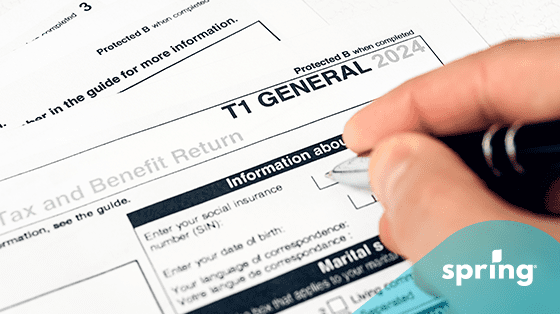
Before we get too far into that, though, the first thing you need to know about is the T1 general form.
The T1 general form is the main form you’re going to need in order to file your annual income tax return. This form declares all of the income you have earned in the last year and is a summary of what you’ve paid and what you owe. It’s required that all Canadians fill out this form and file it every year in order to receive government benefits like the Canada Child Benefit, GST/HST and other benefits.
How A T1 General Works
As we’ve mentioned, the T1 general form is a summary of all of the income you’ve earned over the past year. This form will include all your income and expense information for the last year and condense it all into one place before you submit your annual income tax return.
When you go to fill out this form, there are 5 different sections that need to be completed. These sections are:
- Identification
- Total Income
- Net Income
- Taxable Income
- Refund/Balance Owing
You’ll have determined the correct information for each of these sections when completing your tax return. Let’s take a close look at what each section requires.
Identification
The identification section of the T1 general form requires you to fill out your personal information, including:
- Name
- Address
- SIN Number
- Birth Date
It will also require other personal information that’s pertinent to your tax situation, such as your marital status and/or whether you have a common-law partner.
Total Income
The total income portion of the form will include income from all sources. This isn’t just employment income either. It can also include government benefits, Old Age Security, Canada Pension Plan, Employment Insurance, or any other form of income you may have received.
Net Income
The next portion you need to include is your net income. You may be wondering how this is different from your total income. Well, your total income is your gross annual income. Your net income is the amount of money you earn minus any expenses that you claim.
Taxable Income
Your taxable income is also a different amount. Taxable income is the amount you earn after applicable deductions. This amount can vary because not all of your income is considered taxable. It will also vary depending on provincial and territorial taxes.
Refund or Balance Owing
Finally, the last thing that’s entered into the T1 form is the refund or amount of taxes owing. Depending on how much you earn and what income sources you have, you could either receive money back or you could have tax payable. This is the section that will tell you how much.
How T1 General Forms Differ From T4s
When you take a look at the breakdown above, you may notice that it requires similar information to that of a T4. That is correct; however, they do differ in a few ways.
T4s are given out to employees by employers who’ve paid them more than $500 in a calendar year, not a tax year. These tax forms provide a breakdown of the following:
- Total Income
- Net Income
- Pension Plan Contributions
- EI Contributions
- Union Dues
- Taxes Withheld
- Charitable Contributions
- Special Tax Codes
For some, this may be all they receive and need to claim on their annual tax return. It’s not like that for everyone, though. A T4 only shows you a breakdown of your earnings and contributions for one job or source of income.
If you have more than one job or source of income, then it doesn’t include all of the information you need for a T1 general form. A T1 general form is a breakdown of all of your earnings and income information in one place. This form is then submitted to the Canada Revenue Agency (CRA)in order to complete your annual federal tax return.

T1 General Forms and Notices of Assessments
T1 general taxpayer forms are very similar to Notice of Assessments and, in most cases, will include identical information. This is because the T1 general form is the summary form you submit to the CRA when you file your tax return.
Your NOA is the summary form you receive back from the CRA once your taxes have been filed and approved. As long as your T1 general form is correct and no changes have to be made, then these forms will be the same.
It’s important to remember, though, that even though the information on these two forms is likely the same, the NOA is the official document from the CRA. Because of this, anything you may need your tax information for, such as applying for a loan or mortgage, will require an NOA, even if the information on your T1 is correct.
Where to Find a T1 General Form and Other Tax Forms
When looking into filing your tax return, you’re going to need the correct tax forms. However, that’s only the case if you aren’t filing using a tax service or an online tax program.
If you’re using either of these, then forms are going to be provided for you, likely to be submitted online. This means that you won’t need physical copies of these forms if you choose to file your tax return on paper.
If you choose to file your tax return using paper forms, then you’re going to need copies of the official paper forms. You can access these forms online at canada.ca/get-cra-forms.
You can also call the CRA directly and request an income tax and benefit package that includes the T1 general as well as all the other forms, but you may be required to give them your SIN number.
Finding a Copy of Your T1 General Form
If you’ve already filed your T1 general form and are looking for a copy, then the easiest way to do so would be to go to your CRA MyAccount. Once you’re logged in, you can scroll to the “Tax Returns View” sections, which will provide you with copies of your T1 general form for the most current tax year as well as previous years.
With that in mind, though, the CRA only provides you with copies of your T1 general form for the last 11 years. In order to get copies of your T1 general forms that are older than that, you’ll have to contact the CRA directly.
Accessing Past T1 General Forms
While there are lots of reasons, you may need to access your past T1 general forms. You may need your net and taxable income, self-employment income, or even your RRSP contributions. That said, after you fill out a T1 general, it is sent to the CRA. If you fill out a paper return, then you’ll also supply any supporting documents that are required.
When it comes to getting a copy of these documents, the simplest way is to go through your account on the CRA website. Here you will be able to find your T1 for the past 11 years, as well as the current year. If the specific tax year you’re looking for isn’t on your account, then the best thing you can do is call the CRA, and they can send you a copy.
If you use tax software to do your taxes, your T1s will be saved under your account. This means that you can access the T1 for any return you’ve done using the software.
Correcting Mistakes on the T1 General Form
In order to correct any mistakes on your T1 general form after you’ve submitted it, you have to wait until you get your notice of assessment. This is used to calculate your tax liability, disability benefits, and the amount you pay when you earn taxable income.
Once you get your NOA, you can then submit an amendment request. Once the amendment is processed, your new NOA will come into effect. The thing you need to pay attention to is the number at the bottom though. A negative number means that the CRA owes you money and you qualify for an income tax refund. A positive number means you owe the CRA money, and will need to pay by the tax due date to avoid penalties.
T1 Summary Vs T1 General
Your T1 General is the form you use to prepare and submit your taxes to the CRA. On this form, you are going to claim certain expenses, including:
- Rental income
- Tax credits you qualify for
- Mutual funds in registered accounts
- Childcare expenses
- Tuition expenses
With this primary document, you provide personal details including your social insurance number to calculate net income for the previous year. If you have a business there’s also a business identification section for you to claim the resulting income from earned income and other financial activities on your CRA taxes.
With the T1 tax package itself, you can also get it in accessible formats. These include digital audio, large print, and electronic text also known as e text.
The T1 summary is more commonly known as a Notice of Assessment. This shows you your total net income for the year and a summary of all of your other important amounts. It provides combined totals instead of a breakdown of each specific amount. The T1 general has these amounts and is used to calculate the T1 summary, also referred to as an NOA.
Are There Different Types of T1 General Forms?
In short, yes there are different types of T1 general forms in Canada. The T1 general form is for your personal income taxes. There’s also a T1 business form for your business income tax return and a T2 for corporate income tax returns. If you’re self-employed or a sole proprietor, these are things you may need to consider since you may need to fill out two different returns for self-employment.
Everything You Need to Report On Your Taxes
Your T1 general form is just a summary of everything you’ve reported on your income tax and benefit return. Now that we have an understanding of how that works, it’s important to claim all of the correct information.
It’s important that you claim your income from all income sources, including non-refundable credits, foreign income and investment income. You’ll need to report capital gains, and you also have the option to report any net capital losses. This is the part that gets confusing.
It’s really important that when you file your annual income tax return, it’s filed correctly. This is why many Canadian taxpayers choose to use an account or tax professional. An alternative option is to use professional tax software to help break down the tax process for you.
When To File Your Taxes
You have until April 30 to file your annual tax return. That said, you can start filing your return as early as February, whenever you receive your T4s and other tax documents. While you don’t have to file them so early, you’re able to avoid the tax rush and get your refund faster.
This also gives you more time to pay your annual tax bill once you have the final amount for your tax balance owed. You don’t have to rush to pay by the payment deadline of April 30.
Benefits and Credits Related to the T1 General Form
When you look at the T1 general, you’ll notice that there are key sections. These sections are used to calculate your total net income for the year. This is then used to determine which benefits and credits you qualify for. It will also determine your eligible RRSP contribution room for the year. To determine how you’re going to use that, seeing a financial advisor for investment advice could be helpful.
Final Thoughts
No matter how you choose to complete your annual tax return, it’s important that you pay attention to whether you’ll receive a refund or have to pay a balance owed. If you are receiving a refund, you’ll get a cheque in the mail or receive the funds via direct deposit as long as you’ve given the CRA your direct deposit information. If you owe money, then it’s important that you pay those funds on time to avoid being subject to interest charges and penalties.
When it comes to your T1 general form, you can choose to submit it using paper documents or submit it electronically. Electronically, it is faster, but paper copies are still accepted. It all depends on how you choose to complete your tax return.