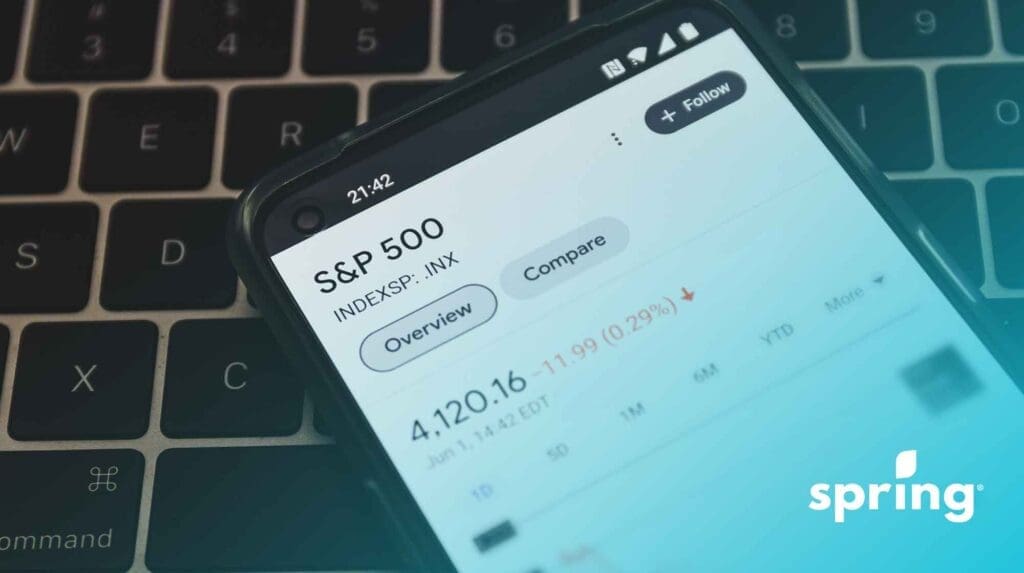
In order to invest in the S&P 500, it’s important to note that there are many different securities that track it. Each one does so a little differently, so your returns on each will vary. Let’s take a look at some of your different options.
Investing in the S&P 500 for Beginners
The simplest way to invest in the S&P 500 for beginners is with index funds. You can do this by investing in ETFs (Exchange Traded Funds) or mutual funds that track the S&P 500 even though it’s not your actual investment. You don’t have to buy stocks individually, and you can diversify your portfolio with just one purchase. Plus, you can choose to invest as much money as you wish.
S&P 500 on Wealthsimple
If you choose to invest with Wealthsimple, there are multiple ETF and mutual fund options that track the S&P 500 index. It’s important to note that the companies listed on the S&P 500 aren’t random, and they’re constantly changing due to the global economy. This means that your investment isn’t guaranteed. You can also choose to invest in a non-registered or registered account. Wealthsimple offers both options.
Purchasing S&P 500 ETFS in Canada
Purchasing S&P 500 ETFs in Canada is actually pretty simple. You can choose to invest on your own using self-directed investing, or you can choose to use a financial advisor or investment manager who can help you manage your investment portfolio. Either way, these ETFs are available to you.
The nice part of investing in S&P 500 ETFs is that you can invest in American stocks without having to invest in the American stock market. There are different tax rules involved with that, so most Canadian investors avoid it and prefer to invest in the Canadian stock market.
Investing in the S&P 500 With RBC
Like most large financial institutions in Canada, RBC offers the ability to invest in mutual funds and ETFs. You can invest in RBC’s own US index, or you can invest in other ones using RBC’s investing platform. Here’s a look at RBC’s ETF.
RBC US MarketSmart GIC
The reason this particular S&P 500 stock is so popular is because it offers the security of a Guaranteed Investment Certificate with a guaranteed minimum return. This means that it’s a great option for those who want to grow their investment while having protection over their initial investment.
If you choose to invest in this index fund, it’s important to note that it’s a non-redeemable and non-transferable investment. This means that you can’t access the funds while they’re locked into a 2, 3 or 5-year term. However, this deposit is CDIC-eligible, has a variable return, and is available in these accounts.
- RRSP
- TFSA
- RESP
- RDSP
- RRIF
- Non-registered accounts
In order to deposit in this account, the minimum investment amount is $1,000. However, because it’s technically a GIC, not an ETF, there are no prices or stats to account for.
Best S&P 500 ETF in Canada
In Canada, there are multiple ETFs that are a good choice for those looking to invest in the S&P 500. While it’s difficult to mention all of the options out there, here are three that are considered to be some of the best. Many of these focus on market capitalization and focus on large-cap companies.
iShares Core S&P 500 ETF (XSP)
This particular ETF holds a portfolio of 500 large-capitalization US companies while hedging currency risk. Like many of the other S&P 500 ETFs is designed for long-term core holding, and it comes at a low cost. However, this ETF is the Cad-hedged version so there’s less currency risk. The unhedged version is XUS. CAD-hedged means that the funds are hedged into US dollars. Here’s what the ETF itself looks like.
| Price | $58.13 |
| Inception Date | May 24, 2001 |
| Management Fees | 0.08% |
| Management Expense Ratio | 0.09% |
| Risk | Medium |
| Volume | 452,515 |
| Net Asset Value | 11.53 B |
| PE Ratio | 24.88 |
| Yield | 1.08% |
Vanguard S&P 500 ETF (VFV)
While the primary purpose of this ETF is also to track the S&P 500, it invests primarily in the US Domiciled Vanguard S&P 500 ETF. This is different from many of the other S&P 500 ETFs. It’s also a passively managed investment that provides exposure to large US companies.
| Price | $130.42 |
| Inception Date | November 2, 2012 |
| Management Fees | 0.08% |
| Management Expense Ratio | 0.09% |
| Risk | – |
| Volume | 341,876 |
| Net Assets | 20.96B |
| PE Ratio | 22.76 |
| Yield | 1.07% |
BMO S&P 500 ETF (CAD)
This is another ETF that tracks the S&P 500. In the case of this one, it provides exposure to diversified US equities. Like many of the other indexes, its holdings consist of the largest as well as the most liquid US stocks.
The reason that many people choose to invest in this stock is because it benefits from local currency appreciation. It’s also meant for those who are looking for growth solutions.
| Price | $81.40 |
| Inception Date | November 14, 2012 |
| Management Fees | 0.08% |
| Management Expense Ratio | 0.09% |
| Risk | Medium |
| Volume | 229,144 |
| Net Assets | 15,627.67 M |
| PE Ratio | – |
| Yield | 0.96% |
Best S&P 500 Index ETF in Canada
When it comes to purchasing an S&P 500 index fund in Canada, you have so many options, whether you choose to go with an ETF or a mutual fund. However, it’s important to remember that each one is a little bit different. This is why doing your research is important. Each one is best for different reasons, and you want to find the one that fits your investing strategy as well as your investing goals. From there, you can narrow it down. However, nothing is a sure bet due to market volatility; all you can do is narrow down your risk.

Is VFV or XUS the better S&P 500 ETF?
When it comes to S&P 500 ETFs, the only difference between the two is that they come from different providers. They both track the same S&P 500 index unhedged, so they yield identical returns. The differences they have include:
- Management fees (VFV, 0.09%; XUS, 0.10%)
- Assets under management
They both have the same currency exposure.
Holding S&P 500 ETFs in TFSA or RRSPs
The main difference between holding an S&P 500 ETF in a TFSA or an RRSP is the 15% US withholding tax. With an RRSP, you can avoid this tax. However, since a TFSA isn’t recognized as a retirement account by the US, you will have to pay the tax.
That said, for long-term growth, TFSAs are also a great choice. Since the dividend yield is typically low, the tax bill is minimal and you can withdraw from a TFSA whenever you like. With an RRSP, there is a penalty for withdrawals.
How Currency Conversion Affects S&P 500 Returns
Your S&P conversions are affected by currency conversions by altering your final gains or losses. These exchange rate conversions can either boost or diminish your total return.
Are Hedged S&P 500 ETFs Worth the Higher Fees?
When you’re looking at investing in a particular investment like hedged S&P 500 ETFs, whether or not it’s worth the higher fees is dependent on how long you intend to hold the ETF and what the currency outlook is. Market performance and market downturns can make it so the values change frequently, which can ultimately hurt your profits.
With hedged ETFs, foreign exchange fluctuations need to be blocked, so ETFs need to continuously buy forward contracts. However, the continuous buying, selling and rolling over of contracts can create constant trading fees and even errors.
What’s the Difference Between S&P 500 and Total Market ETFs?
While both of these types of ETFs contain instant diversification, the main difference is the number of stocks that each one holds. S&P 500 ETFs hold about 500 large-cap stocks, meaning they hold companies considered large in the US economy. They give you broad exposure and built-in diversification.
Total Market ETFs, on the other hand, are also considered to be a good investment and hold the stock of 3,000 – 4,000 successful companies. With these ETFs, you gain exposure to many of the same large-cap companies as well as some mid and small-cap companies, giving you direct investments into the overall market.
Does the S&P 500 or Nasdaq 100 Perform Better Long-Term?
While both the S&P 500 and the Nasdaq are great ways of investing in international markets, making informed financial decisions can make a big difference in your investment returns.
The first thing you should consider before you invest is your risk tolerance. If you have a low risk tolerance, the S&P 500 is a better choice. Its stable long-term performance is good for long-term growth, and it can give you a consistent distribution yield on an annual or quarterly basis. If you have a higher risk tolerance, the Nasdaq 100 is probably your best bet.
RRSPs and the 15% US Withholding Tax Exemption
Under the Canada-US tax treaty, certain registered accounts like RRSPs are granted an exemption from the US withholding tax on US-sourced dividend income. This is one of the popular trading strategies used by Canadian investors. However, if you hold the same thing in a TFSA, you will have to pay the US withholding tax.
Dollar-Cost Averaging into S&P 500 ETFs
Dollar-cost averaging into S&P 500 ETFs involves investing a fixed dollar amount at regular intervals, no matter the price. By doing this, you’re taking market timing out of the equation and reducing the risk of investing a large sum at a market peak. It also gets rid of emotional decisions.
How Often the S&P 500 Index Rebalances
The S&P 500 index rebalances quarterly. These adjustments take place on the third Friday of March, June, September and December. This happens because ETFs consist of multiple stocks, instead of just one company, and these trading days make a big difference in the ETF’s profits.
S&P 500 Dividend Yield and Reinvestment in Canada
With the S&P 500, the dividend yield is approximately 1.04% and 1.06%. That said, due to exchange rates, Canadian investors who hold these usually see 0.72% to 0.82%. This also includes any withholding taxes and any brokerage commissions. The unit value you purchase and any account sales can also affect these returns.
Norbert’s Gambit: Buying VOO/SPY Directly from Canada
When it comes to investment advice and tax advice, many investors recommend using Norbert’s Gambit to avoid currency conversion charges. Instead of using market order to make the most of your commission, you’re going to purchase an investment in one currency and then sell it in another before market close. This allows you to bypass any currency conversion fees.
That said, one of the key takeaways for this is that not all ETFs have this option. However, VOO/SPY do. If you only buy in Canadian currency, though, and have no need for currency conversion, then this isn’t something you need to worry about.
Things to Consider When Investing in S&P 500 Indexes
While we’ve mentioned before that research is important when investing, it’s important to know what to look for. A good place to start is a benchmark index. For this particular fund, the benchmark index is the S&P 500. The index’s performance will help determine the performance of your ETF or mutual fund. Even though your entire index will have a different investment portfolio than the benchmark, the performance is based on it.
Another thing to consider is the index provider; each different ETF will have a different one. Some investors prefer different providers over others. While past performance and investment strategy are still important, this could still be an influencing factor. An example of a popular one is the BlackRock Asset Management Canada.
Other things to consider when choosing your fund are whether it’s an actively managed fund, net assets, your current investment objectives, currency fluctuations, and how your Canadian dollars are affected. This, combined with such performance data, can make a big difference in your investment decisions.
Benchmarks and Investing
Without getting overly complicated, it’s important to note that benchmarks are regulated. This is done by ICE Benchmark Administration Limited, also known as the IBA. It regulates data to verify that all funds benchmark indices give the correct information to the relevant index provider. Things like performance data, historical data (which can impact index history), and anything else related to the market index need to be regulated.
Costs Related To Investing
When investing in the S&P 500, it’s not just trading costs and other financial institution charges you need to watch for. Part of making your informed investment decisions when investing in Index ETFs of this kind is paying attention to the Canadian Dollar Index and how that affects your investment. Unless you invest in a Canadian hedged fund, the dollar will impact your return.
For this reason, many people also choose low cost brokerage accounts whether they’re investing in S&P 500 funds, mid cap stocks, individual stocks or other investments. With transaction costs rising, and changing market prices this can greatly reduce their cost. Especially considering any income taxes payable you may have to account for as well.
Many low-cost trading platforms can provide all the information you need to make smart investment decisions. They provide data on future performance, showcase index-related risks, and provide updates through the applicable performance periods set. Since the fund manager provides any such portfolio rebalancing in the fund, these trading platforms can be a great way to manage your investments. To fund any purchases, you can also just transfer funds right from your bank account.
Final Thoughts
Buying in the S&P 500 in Canada can be tricky because there are so many different options available to you. That said, doing your research can really help you narrow down your choices. You can see the past of the index fund as well as how it will impact your entire portfolio.
It’s also important to keep your investing goals in mind when you choose an index fund. Each index fund is meant for a different type of investing, so paying attention to that can make a big difference in your overall investing goals.