Mobile Home Mortgages
While mobile home mortgages and modular home mortgages are different than traditional mortgages, you are still able to get them for one location. The financing options available for a mobile home depend on the circumstances of your purchase. Whether you own the land or pay a rental fee for leased land makes a difference.
Traditional Mortgage
Getting a traditional mortgage for a mobile home can be difficult, but it is possible if you own the property where you plan to place the mobile home or are buying a property with a mobile home on it. This is normally the ideal option because traditional mortgages often have much lower interest rates than other types of loans.
Personal Loan
Getting an unsecured personal loan or line of credit can also be an option to purchase a mobile home. However, using this option often doesn’t have as high a limit as a chattel mortgage. Getting a personal loan for a mobile is often only possible if the cost is $50,000 or less, though some lenders may go as high as $100,000. While a personal loan often has a higher interest rate than a traditional mortgage, it is often the same as a chattel loan. The main difference between chattel loans and personal loans is that the house secures chattel loans.
Chattel Loan
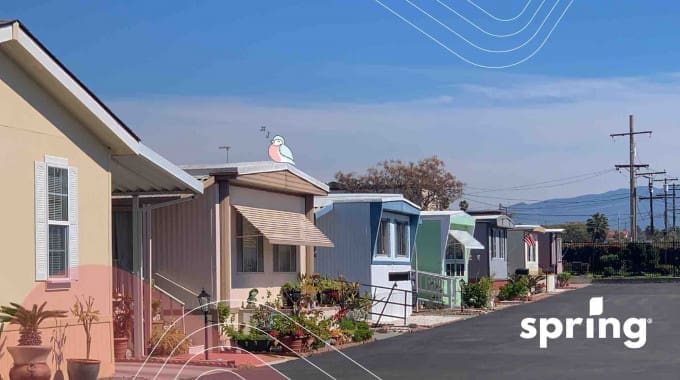
A chattel loan is similar to a traditional mortgage but is structured like a secured personal loan. It is sometimes referred to as a personal property lien. This type of loan is usually given to someone who is purchasing a mobile home on leased land, such as in a mobile home park.
These types of loans typically have a higher interest rate but can also be open loans, which is why they resemble a secured loan. With chattel mortgages, you still have to renew every few years, whichever term you sign for, but you can often renew early because there are no penalties.
Also, if you move the structure, the mortgage transfers with you because it is attached to the building, not the property. Unlike a traditional mortgage, you can put money into the principal of a chattel mortgage whenever you like.
What Down Payment is Required for Chattel Loans?
When you purchase a mobile home in Canada, the standard down payment ranges from 5% to 20%. The down payment you’re required to pay depends on the lender, your credit history, and the specific property. However, to qualify for a mortgage below 20%, you’ll need to qualify for mortgage insurance.

General Information Regarding Mobile Home Financing in 2026
Mobile, or manufactured homes, can be much more difficult to finance, and it’s not just because of the land beneath them. Often, that can make things more difficult because the bank doesn’t have the land to fall back on, but it’s mainly because of how they are built.
Because they are built very differently from single-family homes, they often age faster than traditional housing. Having a shorter lifespan makes it difficult for a bank to justify lending you money for more than 25 years. They may also require an appraisal to verify that the structure is worth what the assessment indicates. This also verifies that the lender will receive a return on their investment and that the structure is worth purchasing.
CMHC Mobile Home Rules
Mobile home purchases can, in fact, be covered by CMHC insurance. This is insurance for the loan in case the buyer is unable to make their payments. It has nothing to do with the type of structure itself. However, standard CMHC requirements must be met.
What about a Manufactured Home?
While it may sound strange, “manufactured homes” is actually a general term that includes modular and mobile homes. The difference between the two is the code the manufactured home has. If the code on the home is A-277, it is considered a modular home, whereas a Z-240 is a mobile home. The term mobile home, though, is used interchangeably between the two, and all the same financing rules apply.
Pros and Cons of Mobile/Manufactured Home Financing
When it comes to getting manufactured home loans, you really have 3 different options, but many people tend to go with a mortgage broker.
Traditional Bank
Getting a mobile home mortgage with a traditional bank is pretty tricky, but definitely not impossible. It really depends on the specifications of the mobile home that you are purchasing. That being said, traditional banks usually have the best interest rates, and you may even be able to get a traditional mortgage instead of a chattel mortgage.
Some negatives are that you are locked into a traditional mortgage and can’t refinance early as you could with a chattel mortgage. Traditional banks also require a lower debt-to-income ratio and a higher credit score than other lenders. They often don’t like to go above 40% of your income going towards debt, whereas other lenders will go up to 50%. Overall, though, getting a mobile home mortgage is very similar to getting a regular mortgage through a traditional bank. Whichever lender you choose, you will most likely need CMHC insurance with a maximum amortization of 25 or 30 years.
Credit Union
If you are unable to go with a traditional bank, a credit union is also a great option. If you have already banked with your local credit union, your chances of approval are higher. Also, more credit unions offer mobile home mortgages than many banks. While they sometimes have higher interest rates, they are often quite flexible, and with a chattel mortgage, you can refinance once you have proven that you can make your payments on time.
Alternative Lenders
Not all alternative lenders will offer mortgages for mobile/manufactured homes, but many will. This has a lot to do with the fact that more and more people are purchasing mobiles, as well as the fact that it is not something many other lenders do. For this reason, though, you can sometimes end up with higher interest rates.
They are often a little more flexible with your credit score, though, as long as you can prove that you are financially stable and able to make your payments. That being said, CMHC rules require a minimum credit score of 600 to qualify for an insured mortgage, which is required for most mobile and manufactured homes.
Mortgage Broker
Ultimately, many mobile home buyers find it very difficult to get a mortgage on their own in 2026. First, it is hard to know which lenders will qualify you, and honestly, it can be daunting to figure out where to start. That is where a mortgage broker comes in.
They go through your finances as well as your credit history to determine what you qualify for, and then, based on the home that you choose, they work to find you the best approval that they can. They can find you a lender who works for you and is compatible with what you plan to purchase.
A-277 (Modular Homes) and Z-240 (Mobile Homes)
While these numbers may not seem super important at first glance, they actually are. All mobiles being bought, sold, or moved must have a valid CSA number, whether CSA 277 or CSA Z240. Every mobile must have this sticker attached as well. It is either on the outside of the trailer or inside the kitchen cupboards; others can be found on the electric panel as well. This specific identification number is registered in the manufactured homes registry, also known as the personal property registry.
CSA A277
Unlike the Z240, the A277 isn’t a building code. It is actually a certification standard. Basically, it can only be used to verify residential, industrial,l or even commercial compliance with certain building standards. The location where this unit is being placed must meet those standards. In Canada, the CSA A-277 certification meets most building standards, while the CSA Z240 does not.
CSA Z240
The CSA Z240 is the National Standard for manufactured and mobile home construction. You can have this type of mobile home in most of Canada, except for Alberta. Alberta requires that you have a CSA A277-standard manufactured home.
Will Lenders Finance an Older Mobile Home?
While it is possible, many lenders don’t like to lend money on a mobile home more than 20-25 years old. There are a few reasons for these age restrictions on units, the first being that mobile homes built before 1995 do not meet current CSA-certified standards.
Another roadblock when purchasing a mobile home is the type of land that it sits on. Mobiles on owned land are simpler to purchase than a mobile on a land lease agreement. This is because when you purchase land, it’s real estate, and land-lease homes are considered personal property.
Typical Ammortization on a Chattel Loan
When using your mortgage approval as a financing solution, many lenders will give you an ammortization ranging from 15 to 25 years. That said, the ammortization you’re approved for depends on whether you’re moving to a land-lease community or a mobile home with land ownership.
Typically, ammortization on chattel loans, where you don’t own the land, is only up to 15 years. However, some lenders have been known to give up to 15 years. If you own the land, though, you’ll likely get 25 years, regardless of your chattel loan down payment.
Can You Finance a Home on Reserve Land?
While you can get reserve land financing, not every financial institution may be willing to lend you money; this includes First Nations’ leased land. One of the main reasons for this is that the law protects reserve property from seizure or mortgage by non-indigenous lenders.
GST on New Manufactured Homes
If you’re purchasing a new manufactured or mobile home, you’re subject to the standard 5% Goods and Services Tax (GST). However, the GST charge applies only to brand-new or substantially renovated manufactured homes. How much you pay depends on whether you purchase the land or just purchase the mobile in a home park.
What is the Cost of Moving a Mobile Home?
When you’re moving a ready-to-move home, you not only have to consider the transport and setup costs, but also other costs. These include:
- Home moving permits
- Skirting installation
- Utility hookup costs
- Reblocking and levelling
- Site preparation
You also need to consider the size of the home and the distance it is being moved. That said, the cost can range anywhere from $3,000 to $25,000. This is just for a pre-built home, though.
If you’re having a factory-produced home assembled on site rather than an existing home, the transportation costs will change. You may be able to get a construction mortgage until the construction phase is complete and the home is finished. Depending on the foundation type, a ready-to-move home, even with the transportation costs, may be the smart move for many buyers.
How Do You Insure a Manufactured Home in Canada?
When you have a manufactured home built, it will come with a serial number, whether it’s factory-built or built on-site. You’re going to need this, along with the CSA registration, foundation documentation, specs, and the home’s location, to get insurance. For many mortgage lenders, this is a requirement for your pre-approval and is part of your closing cost breakdown.
Once you have all this information, you can set up insurance for manufactured homes on the day the purchase closes. The costs can be paid at the same time as your title transfer registration, provincial home registry costs, and GST on new manufactured homes. Any provincial sales tax exemptions will already be factored in.
The Rules on Pad Rental and Property Tax Increases
The provinces govern the rules on pad rentals and property taxes in Canada. For example, pad rental increase rules are overseen by the Residential Tenancy Act in BC under the Manufactured Home Park Tenancy Act. The rent can only be increased once every 12 months, and tenants must be given 3 months’ notice. There’s also a maximum allowable increase set for every year.
If you have to pay property taxes, the amount you pay is determined by your municipality. Your property tax assessment will be mailed to you every year before the amount is due.
Using Sagan and Canada Guaranty as an Alternative to CMHC
While default insurance premiums are needed to get a lower down payment, CMHC isn’t your only option. Both Sagan Mortgage Insurance and Canada Guaranty are popular private alternatives. They allow for more flexible payment options and charge the same federally set rates.
How Do You Sell a Mobile Home?
To sell a mobile home in Canada, you must ensure it has a registered CSA number. Since selling a mobile home is different from selling a modular home or factory-built housing, you can do so with a real estate agent or by using private sale paperwork. Even if you choose to go with a rent-to-own agreement, a bill of sale is required, and the buyer would usually prefer a lien search.
When pricing out the home, resale value trends and lender age limits are used. Pre-1976 units can be more difficult to sell due to safety compliance verification and the big banks. It may not pass a home inspection checklist, even with upgrades and energy-efficient rebates through the Greener Homes Grant. Energy Efficiency can significantly help with the newer homes, though.
Tiny Homes Vs Park Models Vs Mobile Homes
When you’re looking to purchase an alternative home, which one you choose will make a big difference. A mobile home can build home equity and is considered a good investment for long-term mortgages and favourable mortgage terms, which could extend the budget for many homeowners. This is especially true for those looking for a second home.
While they don’t offer the same mortgage features, park model trailers are a good option for those seeking semi-permanent placement in RV resorts and campgrounds. They’re often under 400 square feet, just like tiny homes, but don’t always offer the perks of tiny-home financing, which is best for those looking to live off-grid or wanting the ability to move around.
However, these options are great for those who are looking for their own place without breaking the bank. In fact, they play a key role in making homeownership possible for more Canadians.