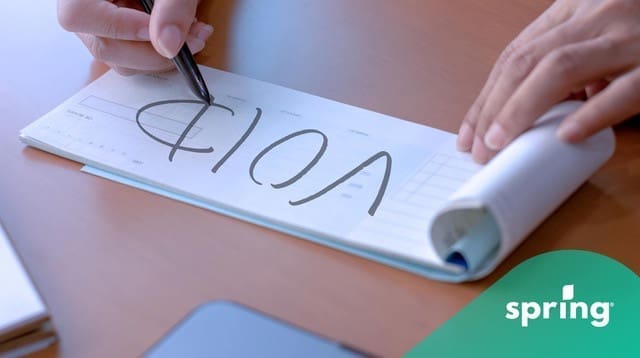
These are all good questions. If you’ve never seen one before, you might not know, but they are important and do contain your direct deposit information.
What is a VOID Cheque?
A void cheque is a blank cheque with “VOID” written across it. This is there so the cheque can’t be cashed. All of your bank account information is on that cheque; if it were blank, someone could use it to withdraw money from your account.
A void cheque is linked to your chequing account and allows you to set up electronic transactions. Depending on what the void cheque is for, only certain information will be required. While cheques cost money, void cheques don’t. They are included in your monthly fees.
The Numbers on the Cheque and What They Mean
When you look at any cheque, whether it’s VOID or not, you will notice that there are numbers at the bottom. 4 sets of numbers that are broken up to be specific. Each set of numbers is important for cashing a cheque or setting up a direct deposit/debit.
If you look at the bottom of the cheque and find the sets of numbers, the first set is the cheque number. This tells you which number from your cheque book it allows you to track. This can be through your own records or with the bank. The 3 other sets of numbers are related to your bank account.
Transit Number
The second set of numbers, after the cheque number, is the transit number. This number refers to the transit number. The transit number is the bank branch where your account was created, also known as your “home” branch. If you bank with an institution that doesn’t have any physical branches, then the transit number will be the same for everyone. The transit number is also sometimes referred to as the branch number.
Financial Institution Number
The third set of numbers is the bank institution number. Every bank and financial institution will have its own number assigned. For example:
- RBC – their institution number is 003
- TD – their institution number is 004
- Scotiabank – their institution number is 002
- BMO – their institution number is 001
- CIBC – their institution number is 010
Account Number
The last set of numbers is your bank account number linked to the cheque. This number will have around 7–12 digits. Each financial institution uses a different number of digits to make up an account number.

Cheques From Different Banks
As we mentioned, depending on which financial institution you bank with, the bank numbers are at the bottom of your cheque. Even the account number will look different. The cheque will also identify the financial institution and the account owner’s name and address in the top-left corner. Even if they are all Canadian banks, they should still differ slightly.
RBC
With RBC, you will find the transit number, institution number and account number at the bottom of the cheque. The institution number will be 003, and the account number should be 7 digits, separated by two spaces. To find a sample cheque, you can do that through your online banking. If you are looking for your routing number, combine your institution number and transit number, adding a 0 in front.
Scotiabank
Just like an RBC cheque, all of your account numbers will be at the bottom of your Scotiabank cheque. The main differences are that the institution number is 002 and the 7-digit account number only has one dash/space. You can also find the routing number the same way.
TD
As you may have noticed, there is only a subtle difference between how all of the cheques are laid out. The difference with a TD cheque is that the institution number is 004, and the account number is 7 digits with no dashes or spaces. The routing number can be found in the same way as with other institutions.
CIBC
For a cheque from CIBC, the institution number is 010. The account number will have 7 digits, separated by a single dash. The routing number can also be found by combining the institution and transit numbers, then adding a 0 in front.
BMO
For a BMO cheque, the institution number is 001. The account number is 7 digits long with one dash. The routing number can also be determined in the same way as the others.
How to Get a Void Cheque
Getting a void cheque is pretty easy, and there are a few ways to do it.
- Use your cheque book: If you have cheques, the easiest way to get a void cheque is to write “VOID” on a cheque. This way it can’t be cashed,
- In person: You can request one from the bank. They will print one off for you right there.
- Online: When you log into your online banking, you will be able to select a void cheque or direct deposit form option. You can then print that off or send an electronic link, depending on your financial institution.
Void Cheque vs Direct Deposit Form
You may be wondering what the difference is between a direct deposit form and a void cheque, and if they’re the same thing. While they are very similar, they aren’t the same thing. That said,d though, they are used for the same purposes.
A direct deposit form is essentially a bank form containing the same information as a voided cheque. This form is required when you start a new position so your employer can directly deposit the money into your account. A void cheque is used for direct debits.
If you don’t need the actual form to set up your pre-authorized debits, many financial institutions will supply your banking details in your online banking through your daily bank statement.
Reasons to Get a Void Cheque
If you haven’t had to get a Void cheque before, there are plenty of reasons why you might need one.
Set Up Direct Deposits
One common use for direct deposit forms and VOID cheques is to set up direct deposit for a new job. The payroll department will use the information to deposit the money directly into your account. While a black cheque contains the same information, you want to be sure your finances are safe. With that said, make sure the VOID isn’t covering any of your banking information.
Set Up Automatic Payments
You can use a void cheque to set up automated payments for some of your monthly bills, like insurance, rent, vehicle payments, and other bills. This is a great idea if you think there’s a risk you might forget to pay your bills. It keeps everything organized and on time.
For Security Reasons
If you have already written a cheque but have made a mistake or no longer need to use it, writing “VOID” on it makes it unusable. To make sure you properly void a cheque, the word void must be in large letters written across it. Voided cheques cannot be used to withdraw money unless it’s to set up recurring expenses; you can’t add a random amount and withdraw the money.
Getting a Void Cheque Online
Depending on the bank that you use, you can either get a void cheque online or a pre-authorized debit form. If you can’t get the cheque, the form still includes your routing number, which consists of your bank transit number and your institution number (also known as your bank branch code). Your account number is also included.
This form is also used for direct deposit setup and is commonly used for payroll authorization with your new employee paperwork. They can even be used for electronic funds transfers and to set up automatic bill payments. In some cases, they’re even referred to as a form of digital banking.
Do All Banks Accept Digital Void Cheques?
In short, yes, they do. Even though banks are strict about account verification and cheque fraud prevention, they’ve found ways to accept digital void cheques and direct deposit forms as alternatives to physical void cheques. As long as the form includes your bank branch codes, financial institution codes, and account numbers, it will be accepted.
Can a Void Cheque Be Used Fraudulently
While cheque cashing rules specify that void protects the cheque from being cashed, and online banking security helps with this, the sensitive information on the cheques can be used to create fraudulent cheques.
While cheque image technology for mobile deposit cheques can help detect these, some do slip past. Sometimes the numbers are used instead to create pre-authorized payments without a physical cheque. These recurring payments (monthly payments) will then have to be cancelled, and you may even need to get a new bank account.
What is a Specimen Cheque?
A specimen cheque is a voided cheque printed by the bank, with the word “void” already written on it. You can’t fill out this cheque, and it won’t be accepted as payment. While you can get the digital versions of these in mobile banking, a bank or credit union can also print them for you with a void cheque request.
Some banks will do a bank verification letter instead of an EFT authorization form. Just like a digital direct deposit form, it will include the bank account details needed to receive direct deposits or to set up paycheques.
Instead of doing this, though, you can also use a cheque from your cheque book. However, it’s important to pay attention to the cheque book order with your cheque numbering system. There’s usually a book you can keep track of these in, if you do personal cheque ordering.
Do Credit Unions Use Different Cheque Formats?
When it comes to cheques, there’s a pretty standardized system. The MICR system is a line at the bottom of the cheque that includes your institution number, bank account number, and transit number, and all banks must have it. It’s also referred to as the cheque encoding line. So your account number format will be the same, even on a credit union cheque.
How to Void a Cheque You Already Wrote
To do a direct deposit cancellation or stop a cheque you already wrote, you’ll have to do a stop payment order through your bank. This can’t be done through a banking app setup and must be done in a branch or over the phone.
Suppose you’re looking to stop a payee authorization that can be deleted through your online banking. A bank account statement request can show you your bank account details and whether the payment was stopped in time. The process is the same for both banks and credit unions.